2009年8月12日 星期三

Analysis of VIII) All Flesh is Grass

This chapter serves an introduction to all the buzz around the word "organic" and its recent phenomenon in the supermarket.

The author immediate takes us to a lively scenery the polar opposite of the processes of the previous section. Green pastures as far the eye could see, Cows running free on farms eating grass, a variety of other animals present. Many different specie of plants are also present: plantain, dandelion, and Queen Anne's lace.

The soil here is rich with fungi worms, and other bacteria that helps to feed the grass.

Located in Swoope Virginia, this farm of many faces is essentially a self sustaining, closed system. Everything is reused in the natural process, even the cow pies are left on pastures as fertilizer. All animals take part in making the grass greener.

Everything on this farm aligns with the image of a farm that most people commonly imagine it as.


source: Tox Town

Yet, the head of the farm, Joel Salavin does not call himself an "organic farmer", instead preferring his goods as "beyond organic" and his preferred title "grass farmer"

Salavin's philosophy is that one does not need all the science to be a good farmer that sells quality goods. In other words, he believes in what works, not what is the truth (which is the essence of science). He believes that the farming nature is infinitely complex.

Comparing this style of farming, this looks like minimal petroleum is used. Hence the calories consumed from this farm is closer to ratio of 1:1 input VS output (eaten) calories. (As compared to 4000+ calories of petro to 90 calories of the processed food).

Farmer Salavin is a stubborn man, he isn't even willing to FedEx his beef to the author, insisting that it is against his principles. Perhaps it's because Flying on the beef on the plane makes it "industrialized". He insists that the term "industrial Organic" is contradictory. I can understand why he thinks this: using transportation adds to the petroleum-to-eaten food ratio, hence "processing" it.

In my opinion, he is almost taking an Amish philosophy: anything to do with industry, technology and oil is seen as evil.

The original meaning of Organic goes like: "nature rather than the machine should supply
the proper model for agriculture"

So what separates Salavin's "Beyond Organic" farm from just an "organic" farm?


source: University of Guelph


The author sets out to investigate.

Analysis of VII) The Meal: Fast Food

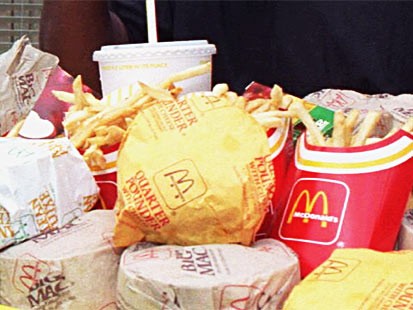
The long awaited meal is finally here; the author finally gets to share a meal of the epitome of processed foods: McDonald's with his family, in their family car.


source: SmartCanucks

Taking a closer look at this highly refined food, the author points the fallacy behind it all: "Rather than eating the corn directly, we feed it to our animals, or process it into other foods, losing up to 90 percent of its energy in the process". Which is implied that, the rest of the calories in the food is filled in by processing (read: petroleum).

All this processing has invented brand new "foods" are can no longer be associated with the plants/animal it came from. Does the Chicken McNugget taste like chicken? The answer is no, it tastes like Chicken McNugget. Does the patty in the burger taste like beef? No it doesn't.
The author asserts that if you ask any American were the Chicken McNugget came from, he/she would likely to just say " McDonald's". In some ways, this is a good answer because the McNugget is essentially a completely separate entity from the chicken it supposedly originated from. The modern day day McNugget is nothing more than a Frankenstein of chemicals and proteins lumped together. The history of the food is completely obscured by all the processing. The dedication it takes to traces out the history of any given item on MickeyD's is just as complex as calculating all the corn content of the items out by hand.

At the end of the, the author claims that the industrial diet has become so dependant on corn, that it is fair to say that its eaters are "corn's koala". Another term, I think , can be applied. Since great measures have been made just to use corn in everything, it is reasonable to say that they are also corn-worshipers, as much as the Aztecs once were.

Dispite being America's comfort food, the author implied that we have to look beyond it, and see its true ties with corn.

Using McDonalds as an example of this over-zealousy over corn, the author summarizes his thoughts on the corn-empire: "The farmers going broke cultivating it; the countless other species routed or emiserated by it; the humans eating and drinking it as fast as they can, some of
them—like me and my family—in automobiles engineered to drink it, too"

We eat more and more - and are left not satisfied, but “simply, regrettably, full.”

To conclude this section, I will bring back a question I've been asking myself throughout: "Are we the masters of corn, or is corn the master of us?"


source: midtowngrid

Epilogue: King Corn is a documentary that focuses solely on the this section of the book. The film makers took a similar approach to investigates how corn has taken over the American food industry.

Analysis of VI) The Consumer - A Repulic of Fat

Super size me, fast food nation!

The effects of over production manifests itself as mega portions and over consumption.
Asian cultures have always looked at the North American culture as "big" - extra-large eggs, big cars, mega highways, huge bags of potatoes chips, and of course, big people.

This cultural characteristic of abundance can be seen in over consumption of corn whiskey in 19th century. A nation wide drinking binge, downing pints of the hard liquor at one sitting. The author encourage the parallel between the drinking binge and the current eating binge.

Both cases, they were dealing with turning excess corn into a non-perishable form, and encourages people to have more of it. There is also a play of human psychology here: people will usually finish whatever that's put in front of them (this may be a product of parents teaching their kids to "finished their food", be it spaghetti to vegetable, which the kids may not like; hence kids will grow up to having the urge to finish their plate.). Playing on yet another part of the human culture, gluttony of the seven deadly sin, the (fast) food industry found that increasing food portions gives people more food, and doesn't make the eater look bad by grabbing seconds.


source: Snarklist

The author points out that the ultimate sacrifice for indulging in all this cheap, over abundant process food: our health. Let's look at the statistics: a baby born in 2000 has
a one third chance of developing Type 2 diabetes in his or her lifetime (for an African American
kid, the chances are 2 in 5), thanks to High Density Corn Syrup contained in virtually every sweetened products. Three out of five Americans are considered overweight.

From another perspective, greed, another of the seven deadly sin here is at play as well. People are hungry for more calories per buck; hence the free choice of picking potato chips vs carrots is also at play here.

People continues to eat like this despite all the health warnings; partly because junk food tastes good. It is an instant gratification.

To conclude the chapter, the author places the blame of unhealthy Americans on their agricultural policies: “we subsidize high-fructose corn syrup in this country, but not carrots.” Until we change our policy, “the river of cheap corn will keep flowing.”


source: KG Studios Oakland

However, food source can not be solely be blamed for the American obesity frenzy. The lack of exercises to be blamed as well.

For example, a teacher in Edmonton followed the McDonald's diet made famous by the documentary "Super Size Me", and worked out six times a week. He ended up loosing weight, and a drop in blood pressure.

Article from CBC

We cannot place blame on just food alone; however, this is a good food for thought.

The term "junk food" was coined for a reason, and should take into account of "you are what you eat", then the implications are obivious...

Analysis of V) The Process Plant: Making Complex Foods

The machine continues to grind...

So how does corn eventually become one of the following? “Adhesives, coatings, sizings, and plastics for industry; stabillizers, thickeners, gels, and viscosity-control agents". That is just a fraction of the contents of the delicious sweet Pepsi .

The processing of corn is long and mostly secret kept by the industry (who would want an investigative journalist snooping around your business, who may find evidence to expose your operations?) Instead, the author studied this process at Center for Crops Utilization Research at Iowa State University.

Source: Cattle Network


But the result after producing all these different products is virtually zero waste. The waste water can even be reused to make animal feeds. Looking at it from this perspective you could almost pretend this process is green. But did you know that corn is the key constituent of “margarine, Tang, Cheez Whiz and Cool Whip”? Those are all essentially food imitators they can provide sustenance but they won’t really sustain us.

According to the author, the logic of packing as much corn content into a food product is a combination of two things: a vicious cycle of business senses.

The cycle starts with the fallen price of corn, turning it into a commodity. The company then seeks to add value to their cheap commodity by processing it (essentially selling a service on top of the commodity). When that isn't enough to drive up prices, the companies look add even more value (read: calories) to the processed food item.

“In many ways, breakfast food: four cents' worth of commodity corn (or some other equally cheap grain) transformed into four dollars worth of processed food. What an alchemy!”

The author also talks about how processing food is very ineffective use of energy: "for every calorie of processed food it produces, another ten calories of fossil fuel energy are burned."
Essentially, what t industry doing here is wasting energy, tying the greenhouse effect to the food industry.

In addition, since there is a giant surplus of corn, industry needs to cram get rid of all that surplus biomass somewhere. Exploiting the human desire for sweet stuff, High Fructose Corn Syrup is born. Following this logic leads to the conclusion that Americans are fat for a reason, they are doing their part to consume all excess biomass, as efficient as possible.

An interesting comparison that the author's used: The Jetson's the meal-in-a-pill to our processed foods, aka the pill-in-a-meal.

source: One for the Table


Are we just fooling ourselves that we're living in the space age?


2009年8月11日 星期二

Analysis of IV) The Feedlot: Making Meat

This is the chapter where the author opens up the Pandora's box of industrial beef.
This is the chapter he referred to in the introduction, about spoiling appetites.
This chapter is mind blowing for a meat lover.

Following the trail of corn into the industrial feedlot of Kansas, and into the mouth of steer # 534.

What seemed like a simple process of growing cows, waiting for them to get fat, then sending them into the slaughter house, is in fact, a downright violation of evolution and biology.


source: The food futurist

Filling in the blanks: this industry beef producing "machine" (as this entire chapter depicts this) causes pollution, toxic waste, and deadly pathogens in the form of a massive manure lagoon. It’s a simple matter of biology that not only allows cows to live off of grass it makes them uniquely suited to do so.

The presented are that, forcing cows to off of corn is not only unnatural, it’s dangerously unhealthy. The feed are filled with antibiotics, growth hormones, and synthetic protein and fats from other cows; it is implied that super bugs developed from the antibiotics may just end up in someones hamburger.

“Most antibiotics sold in America today end up in animal feed, a practice that, it is now generally acknowledged (except in agriculture), is leading directly to the evolution of new antibiotic-resistant superbugs.” These antibiotics are only necessary because we insist on forcing cows to live off of corn .

All that cheap corn that fattens up the cow is also fattening us up with excess saturated fat.

This pounding information is all tying into a common theme: that humans tries to create an biological system intended for industry, defying mother nature, and creating new problems that originally took care of itself!

Cow stomach gassed up due to corn? no problem, just add medicine to the feed! Not only that, the cows are NOT naturally designed to live in over crowded pens!

This is certainly parallels the peak of the industrial revolution in London. People moving into cramped and filthy cities from the country side, polluted living quarters of the workers, dangerous working conditions. (Compare this with the life of steer 534)


source: Industrial Revolution


The implication here is strong: the industrial cattle producing "factory" is filling a hole by digging another.

Taking this logic further, not only is this method of making meat damaging to the environment, but also ourselves; the cattle's goes through a life of suffering in the pen, us humans are the linked directly to these animals, we will have to pay the price eventually.

The cows are slowly dying everyday because we insist on growing more of a certain crop then we need and instead of growing less we are force feeding it down their throats so we can save ourselves some money.

This process reminds me of a term "stuffing the duck" in Chinese, it describes force-feeding, jamming food in a duck to fatten it before slaughter.

According to the author, if we assume that "we are what we eat", then we are not far from corn and oil...

Analysis of III) The Elevator

The once sacred corn of the Aztec past:

"If they saw dry grains of maize scattered on the ground, they
quickly gathered them up, saying "Our Sustenance suffereth, it
lieth weeping. If we should not gather it up, it would accuse us
before our Lord. It would say, 'O, Our Lord, this vassal picked
me not up when I lay scattered upon the ground. Punish him!'
Or perhaps we should starve."

...has been reduced to an over abundant mountains of dust and pebble thanks to the modern industrial processing.

The author intended to follow Corn form the Naylor farm all the way to the human belly, but he realized it was an futile attempt. As futile as wanting to trace a cup of water to the ocean after it has been dumped into a river.

vs
sources: The International Centre for Environmental Management and Go!

The author is then forced to assume that all corn planted and used in the industrial process is equivalent (referring back to the water analogy).

From this perspective - corn is a lot like water. In that it is in fact both are precious resource globally, yet the North Americans can treat it like an endless cheap supply.


source: Louisiana Department of Agriculture & Forestry

2009年8月10日 星期一

Analysis of II) The Farm

The previous chapter talks about the lineage of corn, this chapter focuses on the actual lifetime of corn, essential from cradle to grave.

The author also highlights the irrationality behind why corn came to be as massive as it is today. Supporting the creation of mountains and mountains of corn, is actually humans playing god; essentially creating a flawed system that is creating more problems then it solves.

He paid a site visit to an Iowa corn farm, owned by a third generation corn farmer by the name of George Naylor. A lot has changed since the time Naylor's grandfather stat to farm corn; the synthetic fertilizers came, the irrational government policies came, and the "endless" demand came.


source: Environmental Workshop Group

Bound to the rise of king corn* was also the dawn of the chemical fertilizer industry. In 1947, the US government found itself with a surplus of ammonium nitrate from WWII. Since corn is the biggest eater of synthetic nutrients, this excess chemicals found the perfect mouth to cater to.
This process removes the need that farming requires any sunlight at all. Petroleum processes the chemicals to feed the corn.
It can also be noted that the Chinese government's requested aid from the west in 1970s in the form of chemical fertilizers in order to kick start their economy.


Essentially we're eating and drinking corn and the petroleum which feed from corn.

The facts and figures presented shows us that the farmer s are actually loosing money for every hectare of corn they grow, so why keep on with this madness? It turns out that US agricultural policies subsidizes the corn farms to grow as much corn as possible, creating an artificial demands, which results in excess supply of corn, hence driving the price of corn to the floor. Since corn is the cheapest "resource" (What the author is presenting this a utterly senseless negative feedback loop.

This massive planting of corn is changing the farm landscape as well. Because the industrial process of planting corn is too efficient, there are fewer farmer to plant corn. In a way, corn is driving people out. Which brings up the question yet again: which is the dominant species here?

So who profits from all of this seemly nonsense? The food corporations? The banks? The tractor companies?

maybe all of them.